Structural Steel Fabrication in West Sacramento, California
West Sacramento is 12 miles from our shop — straight down Highway 50, across the river, about twenty minutes. It is a different industrial animal from the city it shares a name with, and the reason is the water.
This is a deep-water port city. Ocean-going ships come 40-odd miles up a dredged channel from Suisun Bay to a terminal a few minutes from downtown Sacramento, which is why West Sacramento's industrial base is built around bulk handling, rail, and heavy freight rather than around offices. Structural steel here runs heavier than it does across the river, the loads are less forgiving, and the ground it all sits on is protected by fifty miles of levee.
Coverage
- 12 mi
- Rancho Cordova shop to West Sacramento, Highway 50 west
- ~20 min
- Drive time. Same-day site walks are routine.
- 300 mi
- Inside the full EPC and preventative-maintenance band
- 600 mi
- Field services, fabrication delivery, and rigging
What We Build for West Sacramento Facilities
Heavy structural steel. Beams, columns, transfer towers, conveyor supports, bulk handling structures, and equipment platforms sized for material handling rather than for office loads. Port-adjacent work carries real tonnage and the connections have to be designed for it.
Terminal and bulk handling structure. Support steel for conveyors, hoppers, chutes, silos, and transfer points, plus the wear components that abrasive bulk material destroys on a schedule.
The full detail
Rail-served facility steel. Loading and unloading structures, dock steel, access platforms, and the guarding around track where people and equipment share space.
Tank and vessel structural work. Access platforms, ladders, cages, and structural rehabilitation on water, process, and wastewater tanks — including work that has to happen while the tank stays in service.
Food and beverage process equipment. Custom processing equipment, sanitary and washdown-rated enclosures, tank platforms, and support steel for the co-packing, beverage, and food distribution operations along the industrial corridor.
Warehouse and distribution steel. Mezzanines, dock and access steel, safety guarding, column protection, and bollards for large-format distribution buildings.
Corrosion-exposed steel. River air, high groundwater, and wet ground change the specification. Coating systems, galvanizing decisions, and connection detailing get set for the exposure rather than copied from a dry inland job.
What West Sacramento Actually Handles
The Port of West Sacramento is the anchor. It sits at the head of the Sacramento River Deep Water Ship Channel — roughly 40 miles of dredged channel at a 30-foot depth — which makes it one of only two inland deep-water ports in California. Rice moves out through it; cement and bulk materials move in, with Cemex operating an active cement terminal on port property. Bulk handling at that scale means conveyors, silos, transfer towers, dust control, and structures that live outdoors in river air.
Raley's is headquartered here at 500 W Capitol Ave — a grocery company running on the order of 11,500 employees across its core banner, with the distribution and refrigeration infrastructure that implies. Tony's Fine Foods, a specialty food distributor now part of UNFI, operates from Reed Avenue. Clark Pacific, one of the West's larger precast concrete manufacturers, is headquartered on Riverpoint Court.
The full detail
Bayer maintains a Crop Science presence in the city along with a small research incubator opened in 2025 — worth noting because the larger biologics research site that operated here was sold to Ginkgo Bioworks in 2022, so older descriptions of West Sacramento as a Bayer biologics headquarters are out of date.
The food and beverage manufacturing side has been through real turbulence. The large beverage co-packing plant on the industrial corridor shut down in October 2025 under one owner and was reacquired shortly afterward by a newly formed operator, Redwood Beverage Group, which is restarting co-packing at the same 200,000-square-foot site. That is worth knowing because a plant coming back online generates exactly the kind of equipment, platform, and process-support work we do — and because the "Nor-Cal Beverage" name long associated with that facility no longer operates there.
Geographically the work concentrates in a belt: the port and its terminals, the Industrial Boulevard and Enterprise Boulevard corridors, the older Bryte and Broderick districts to the north, and the rail-served parcels between them.
Getting to Your West Sacramento Facility
12 miles, about twenty minutes, straight down Highway 50 and across the river. The port, Industrial Boulevard, Enterprise Boulevard, and the Bryte and Broderick areas are all inside a twenty-five-minute drive from our shop.
That proximity means we iterate rather than front-load. Field-verify in the morning, bring a template back the same afternoon, confirm fit before committing material to a full run. For heavy structural work landing on existing foundations and tying into existing steel, that back-and-forth is worth more than it sounds — the cost of a heavy assembly that does not fit is measured in crane time, not in shop hours.
West Sacramento also pairs naturally with Woodland and Davis on the same run up I-5 or out I-80, and there is no mobilization charge to come look at something twelve miles away.
Two West Sacramento Constraints Worth Planning Around
Almost the whole city is behind a levee, and that changes where equipment can sit. West Sacramento is protected by roughly fifty miles of levee and has a long flood-vulnerability history. The West Sacramento Area Flood Control Agency is working with the Army Corps of Engineers on a levee improvement program authorized under the 2016 WIIN Act, aiming at 200-year protection with a horizon into the 2040s and cost estimates in the billions. For a facility project, the practical consequences are about elevation and detailing rather than about steel grade. Mechanical and electrical equipment frequently has to be elevated above a design flood elevation, which turns "set the unit on a housekeeping pad" into "design a platform to a specified height with access and seismic restraint." Materials and connections below that elevation may need to tolerate inundation. And permitting for work in a mapped floodplain carries its own review. We ask about the design flood elevation early, because it is a structural requirement disguised as a paperwork question. Confirm your site's requirements with the city and your floodplain manager.
Bulk material destroys steel on a predictable schedule. Cement, aggregate, rice, and grain moving through chutes, hoppers, and transfer points wear metal away, and the failure is abrasion rather than overload. The useful conversation about a worn transfer is almost never "build the same thing again." It is whether a heavier plate, an abrasion-resistant material, a changed transition angle, a liner system, or a different flow geometry would extend the interval. We would rather look at how and where the last one failed and design the replacement to last longer, and we will tell you when the answer is a liner instead of a whole new chute.
Published 2026 Budget Pricing
We publish our numbers. Nobody else in this market does. Heavy structural, terminal, and bulk handling work is quoted per project; the ranges below cover the standard structural and access scope.
| Item | 2026 budget range |
|---|---|
| Heavy industrial steel mezzanine | $35,000–$75,000+ |
| Light-duty steel mezzanine | $18,000–$35,000 |
| Guardrail system, 42" OSHA | $165–$225 per linear foot |
| Fixed ladder, 20–30 ft | $3,500–$7,500 |
| Steel-framed roof access hatch | $3,500–$8,000 |
| Standard steel bollards | $450–$850 each |
| Removable or locking bollards | $1,500–$3,500 each |
| Mechanical or generator enclosure | $8,000–$25,000+ |
Fabrication only. Final pricing moves with material selection, structural requirements, engineering review, finish type, complexity of fabrication, and project scope and quantity. Installation is quoted after a site visit and field review. See the full 2026 price guide →
Related Work
Water tank structural rehabilitation → — Structural rehabilitation and access steel on a tank. Directly relevant to West Sacramento's water, wastewater, and process-tank inventory, and to any structure with sustained moisture exposure.
Dust collection and air handling → — Ducting, hoods, and support steel routed through an operating facility. Applicable to bulk material handling, where dust control is both an air-quality and a housekeeping requirement.
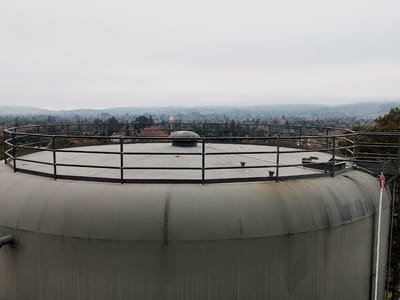
WATER TANK — PERIMETER GUARDRAILWASTEWATER · DWG PRJ-06 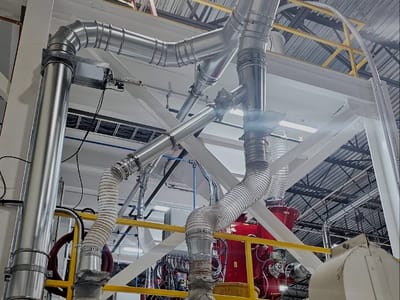
DUCT AND PIPE — HUNG AND BRANCHED


Service area
Nearby
Divisions
Related services
Structural Steel Fabrication and Erection
Structural and miscellaneous steel fabrication in Rancho Cordova. Platforms, mezzanines, supports, and access systems. Engineers on staff who stamp.
In-House Rigging and Equipment Setting
Fully in-house industrial rigging. Receive, offload, stage, and set equipment with our own personnel. 600 miles from Sacramento.
Utility Tie-Ins and Process Piping
Process utility piping, industrial plumbing, secondary containment, air and environmental systems. Bundled with a project or contracted standalone.
Industries
Industries this work runs in
Food and Beverage Processing Equipment Installation
Food and beverage processing equipment installation inside live plants. Sanitary supports, utility tie-ins, washdown design. 600 miles from Sacramento.
Wastewater Treatment Structural and Mechanical Work
Wastewater treatment contractor for structural steel, tank rehabilitation, guardrail and access systems, process piping, and equipment installation.
Packaging Line Installation and Integration
Packaging line installation and integration. Fillers, cappers, labelers, case packers, palletizers, conveyors. Set, tied in, and ready to commission.
Portfolio
Related project work
Industrial Water Tank Structural Rehabilitation
Industrial water tank structural rehabilitation, railing and access improvements, and elevated field welding on an in-service tank.
Dust Collection and Air Handling System Installation
Dust collection and environmental system installation, including a large-scale process enclosure and air handling package inside operating facilities.
Coverage
- 600 mi
- Field services, installation, fabrication delivery, and rigging from Sacramento
- 300 mi
- Full EPC delivery and preventative-maintenance programs
- Nationwide
- Engineering, design, and fabrication for shipment
Frequently Asked Questions
Does the design flood elevation affect a steel project here?
More than most people expect, and it is worth raising in the first conversation. Because most of the city sits behind levees in a mapped floodplain, mechanical and electrical equipment often has to be elevated above a specified design flood elevation. That converts a simple equipment pad into an engineered platform with a defined height, access, and restraint — a structural scope rather than a concrete one. Materials and connections below that elevation may also need to tolerate inundation. Tell us the design flood elevation for your site if you know it, and confirm the requirement with the city and your floodplain manager.
Can you build heavier structural steel than typical commercial work?
Yes, and port-adjacent projects are where that shows. Bulk handling structures, transfer towers, conveyor supports, and equipment platforms carry loads that a commercial mezzanine detail will not handle, so the members, the connections, and the anchorage all get designed for the actual load case. Our engineers do that design in house, which matters when the load path has to be traced from a hopper down through existing steel to an existing foundation.
Our transfer chute keeps wearing out. Can you just copy it?
We can, but we would rather ask two questions first: what failed, and how fast. Abrasion failures are usually design problems in disguise, and the fix is often a heavier plate, an abrasion-resistant material, a different transition angle, a liner system, or a change in flow geometry rather than an identical replacement. Sometimes the honest answer is that a liner fixes it for a fraction of the cost of a new chute. Send photos of the wear pattern along with the interval and we will tell you which one it is.
How does river air and high groundwater change the specification?
Mostly at the bottom and at the connections. Sustained moisture attacks base plates, anchor bolts, and the lower portion of columns, posts, and bollards well before the rest of a structure shows anything, and it collects wherever a detail traps water. For West Sacramento work we specify the coating system, use galvanizing where it makes sense, and detail connections to drain rather than to hold. It costs more up front and it is the difference between a structure that lasts and one that needs attention in a few years.
Do you work at the port itself, or only at private facilities?
Both, with the understanding that port and terminal work carries requirements a private site does not — access control and badging, coordination with vessel and rail schedules, restricted staging, and heavy-lift planning around active operations. Those are planning items rather than obstacles, but they need to be settled before mobilization. → **
Is twelve miles close enough that you will look at a small job?
Yes. At twenty minutes there is no mobilization charge to come measure something, and small work makes sense here in a way it does not at two hundred miles. We would rather spend an hour on your floor than quote from a drawing that describes the facility as it was before the last three expansions.
Call (916) 842-7402
Send drawings, a photo, or a rough scope. We answer with questions before we answer with a number.
Miller 3 Engineering · 2530 Mercantile Dr Ste H, Rancho Cordova, CA 95742 · CA LIC #1136711