
CAL/OSHA 8 CCR §3277(g)(2) · 29 CFR 1910.28(b)(9) · CA TRIGGER: 20 FT
Fixed Ladder Fall Protection: The California 20-Foot Trigger
California is stricter than the federal rule. If you have been counting ladders at 24 feet, you have been counting the wrong ones.
Miller 3 Engineering fabricates and installs custom fall-arrest systems for existing ladders, and builds new fitted fixed ladders with approved fall-arrest systems.
- 20 ft
- California trigger under Cal/OSHA 8 CCR §3277(g)(2)
- 24 ft
- Federal trigger under 29 CFR 1910.28(b)(9). Higher, and not the one that governs a California workplace
- 4 ft
- The band between them where California facilities routinely find ladders they thought were out of scope
- 0
- Ladder cages that count as a fall-arrest system
The number that governs your plant is 20 feet, not 24
Most fall-protection conversations in this industry cite the federal rule. In a California workplace, that is the wrong reference.
Cal/OSHA, Title 8 CCR §3277(g)(2) requires that cages or wells be provided on fixed ladders of more than 20 feet, to a maximum unbroken length of 30 feet. Federal OSHA, 29 CFR 1910.28(b)(9), sets its trigger at more than 24 feet.
The full detail
Cal/OSHA enforces the California standard in California workplaces. So a facility that inventoried its ladders against the federal 24-foot number has a four-foot blind spot, and in a plant with tank ladders, silo access, and roof ladders, that band is rarely empty.
Practical translation: if you have already counted, count again at 20 feet. Most facilities find more ladders in scope than they expected.
What actually obligates you today
Three triggers. Only one of them is a future date, and it is the least reliable of the three.
1. The California height trigger. Active now.
Cal/OSHA 8 CCR §3277(g)(2), fixed ladders over 20 feet.
2. The repair and replacement trigger. Active now, and the one most facilities miss.
Under 29 CFR 1910.28(b)(9)(i)(C), when a fixed ladder or any section of one is replaced, a personal fall arrest system or a ladder safety system must be installed in at least that section at the time of the replacement. You do not get to rebuild a corroded ladder section to the old configuration. Touch it, and it comes up to the current standard.
3. The new-installation trigger. Active since 2018.
Any fixed ladder installed on or after November 19, 2018 must already have a personal fall arrest system or a ladder safety system, not a cage or a well.
Do not build a capital plan on it, in either direction
The federal standard, 29 CFR 1910.28(b)(9)(i)(D), states that on and after November 18, 2036, all fixed ladders must be equipped with a personal fall arrest system or a ladder safety system.
Two corrections worth making, because both directions of error are common.
The full detail
The date is not January 1, 2036. A number of circulated flyers and vendor sheets print that date, including material in circulation locally. The published standard says November 18. If you have a compliance calendar built on January 1, it is citing something that does not exist.
And the deadline itself is under active reconsideration. OSHA published a proposed rule in the Federal Register on April 6, 2026 that would eliminate the retrofit deadline and allow existing ladders with cages or wells to remain in service. Until a final rule issues, the 2036 requirement remains in the published standard. But it is not a date to build a ten-year capital plan around, because it may not survive.
What does not change if the federal deadline disappears: the California 20-foot trigger, the repair and replacement trigger, the 2018 new-installation requirement, your insurer's position, and the fact that a fall from a fixed ladder is the same fall either way.
Do not wait on Washington to decide whether to fix a ladder that Cal/OSHA and your insurance carrier already have an opinion about.
Count your ladders. At 20 feet. That is the whole first step.
Most facility managers cannot answer, off the top of their head, how many fixed ladders they own or how tall each one is. That is not negligence. Ladders get installed with equipment, with tanks, with roof units, and with buildings, over decades, by different contractors, and nobody ever assembled the list.
But the list is the project. Once you have a count and a set of heights, you know:
- How many ladders clear 20 feet. Those are in scope under the California standard.
- Which are worth retrofitting and which are cheaper to replace. Corrosion, non-compliant geometry, and bad mounting frequently make replacement the better economics. And replacement triggers the current standard for that section anyway.
- What the budget is. Which lets you phase the work across several capital cycles.
The facilities that get caught are not the ones that miss a deadline. They are the ones that repair a ladder section without knowing the repair itself carried an obligation.
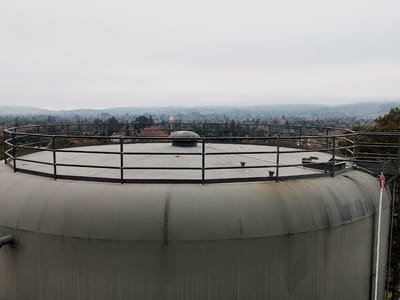
WATER TANK — PERIMETER GUARDRAILWASTEWATER · DWG PRJ-06 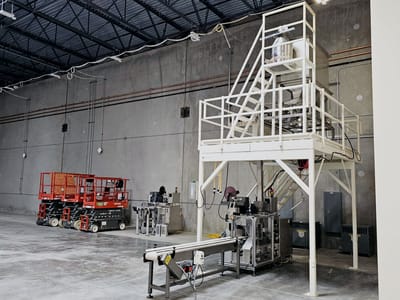
ACCESS PLATFORM — CONVEYOR AND HOPPER


The retrofit path
We walk the facility and inventory every fixed ladder: location, climb height, mounting condition, top-of-climb arrangement, existing cage or well, corrosion and structural condition, and photographs of each one.
Under 20 feet, outside the §3277(g)(2) height requirement. Over 20 feet, in scope, then sorted into retrofit candidates and replacement candidates. We also flag anything installed on or after November 19, 2018, which already carries the fall-arrest requirement regardless of height band.
The full detail
A number per ladder and a total, organized so you can stage the work by building, by priority, or by capital year.
Fall-arrest system selection and attachment design. The system has to anchor into something structurally adequate, which on an old ladder or an old tank shell is not a given.
Custom fall-arrest system fabrication for existing ladders, or complete new fitted fixed ladders with approved fall-arrest systems, built in our Rancho Cordova shop.
Sequenced around your operations. Ladder work is elevated work, so access, fall protection for our own crew, and coordination with plant activity all get planned rather than improvised.
Photo documentation and a record of what was installed where, which is what you will want when somebody asks you to demonstrate compliance.
Survey
We walk the facility and inventory every fixed ladder: location, climb height, mounting condition, top-of-climb arrangement, existing cage or well, corrosion and structural condition, and photographs of each one.
Classify against the California trigger
Under 20 feet, outside the §3277(g)(2) height requirement. Over 20 feet, in scope, then sorted into retrofit candidates and replacement candidates. We also flag anything installed on or after November 19, 2018, which already carries the fall-arrest requirement regardless of height band.
Budget and phase
A number per ladder and a total, organized so you can stage the work by building, by priority, or by capital year.
Engineer
Fall-arrest system selection and attachment design. The system has to anchor into something structurally adequate, which on an old ladder or an old tank shell is not a given.
Fabricate
Custom fall-arrest system fabrication for existing ladders, or complete new fitted fixed ladders with approved fall-arrest systems, built in our Rancho Cordova shop.
Install
Sequenced around your operations. Ladder work is elevated work, so access, fall protection for our own crew, and coordination with plant activity all get planned rather than improvised.
Document
Photo documentation and a record of what was installed where, which is what you will want when somebody asks you to demonstrate compliance.
Retrofit or replace
| Condition | Usually points to |
|---|---|
| Sound ladder, good mounting, compliant geometry, over 20 ft | Retrofit with a fall-arrest system |
| Significant corrosion in rails, rungs, or brackets | Replace. Note that replacing a section triggers the current standard for that section |
| Non-compliant rung spacing, standoff, or side rail extension at the top | Replace |
| Ladder mounted to a structure that cannot carry the arrest load | Replace, with new anchorage design |
| No safe landing or transition at the top of climb | Replace or add a platform and gate |
| Cage present, otherwise sound | Retrofit. A cage is not a fall-arrest system, and the fall-arrest system usually goes in alongside or in place of it |
| Installed on or after November 19, 2018 with only a cage | Retrofit now. This one is not a future obligation |
| Multiple short ladders that could become one continuous run | Evaluate. Sometimes the best answer is a different access design entirely |
We tell you which, per ladder, with the reason. We do not default to replacement because it is a bigger invoice.
Personal fall arrest system or ladder safety system
Both are accepted. They are not the same thing, and the difference matters on a fixed ladder.
| Personal fall arrest system | Ladder safety system | |
|---|---|---|
| What it is | Full-body harness, connector, and anchorage | Carrier rail or cable running the ladder's full length, with a sleeve or trolley the climber attaches to |
| How it works | Arrests a fall after it starts | Built into the ladder, arrests a fall without the climber identifying anchor points |
| Practical fit | Better where climbs are occasional and anchorage exists | Usually the better retrofit for a fixed ladder, because it protects every climb without per-climb rigging decisions |
Most of the retrofit work we do is a ladder safety system, for the reason in that last cell.
What we do
| Offer | Detail |
|---|---|
| Custom fall-arrest system fabrication and installation for existing ladders | Rail or cable system selection, attachment design, fabrication of brackets and modifications, and installation |
| New fitted fixed ladders with approved fall-arrest system and install | Complete replacement ladder, engineered, fabricated, and installed with the system integrated |
| Ladder survey and inventory | Count, heights measured against the 20-foot California trigger, conditions, photos, and a phased budget |
| Access redesign | Platforms, landings, transition arrangements, self-closing gates, and guardrail at the top of climb |
| Guardrail and access packages | Where the ladder problem is really an access problem |
Published pricing for reference: a new fixed ladder in the 20–30 foot range runs $3,500 – $7,500, fabrication only. Retrofits are quoted per ladder after survey, because condition and mounting vary too much for a standard range.
The cage was never a fall-arrest system. It was a hope.
Ladder cages were installed for decades on the theory that a falling climber would contact the cage and slow down. In practice, cages do not reliably arrest a fall, they can worsen injuries during one, and they complicate rescue.
That is why both the federal retrofit provision and the 2018 new-installation requirement call for an approved fall-arrest system: a system that physically catches the climber, engineered to arrest the fall.
California's §3277(g)(2) still speaks in terms of cages and wells above 20 feet, which is why the two standards have to be read together rather than one at a time. A ladder can satisfy the California caging requirement and still be the ladder that hurts somebody.
Where the over-20-foot ladders usually are
If you are starting an inventory, check these first. They are where we find them.
- Silos, bins, and hoppers
- Water and process tanks, including elevated tanks
- Roof access from grade on tall single-story buildings
- Dust collectors and baghouses
- Cooling towers
- Elevated conveyor and catwalk access
- Boiler and stack access
- Multi-level process structures and equipment platforms
- Exterior building access ladders that pre-date the current roof hatch
The 20-to-24-foot band in particular tends to hide in single-story roof access and mid-height tank ladders, which is exactly the equipment a federal-trigger inventory skips.
Coverage
| Service | Coverage |
|---|---|
| Survey, fabrication, and installation | 600 miles from Sacramento |
| Fabrication and shipping only | Nationwide |
| Engineering and design only | Nationwide |
| Ongoing inspection within a maintenance program | 300 miles from Sacramento |
Divisions
Related services
Structural Steel Fabrication and Erection
Structural and miscellaneous steel fabrication in Rancho Cordova. Platforms, mezzanines, supports, and access systems. Engineers on staff who stamp.
Subscription Preventative Maintenance Programs
Subscription preventative maintenance within 300 miles of Sacramento. Scheduled visits, consumables, safety-device checks, photo-documented reports.
Industries
Industries this work runs in
Manufacturing and Assembly Line Equipment Installation
Manufacturing and assembly line equipment installation in live plants. Rigging, structural supports, utility tie-ins, commissioning support.
Wastewater Treatment Structural and Mechanical Work
Wastewater treatment contractor for structural steel, tank rehabilitation, guardrail and access systems, process piping, and equipment installation.
Products
Related fabrication products
Commercial Ladders and Roof Access Hatches
Fixed ladders 20-30 ft at $3,500-7,500, steel framed roof access hatches $3,500-8,000. Fall-arrest retrofits built to the California 20-foot trigger.
Steel Mezzanines: Light Duty and Heavy Industrial
Light duty mezzanines $18,000-35,000, heavy industrial $35,000-75,000+. Designed, stamped, permitted, fabricated, and installed by one shop in Sacramento.
Portfolio
Related project work
Pricing
Published 2026 budget pricing
Miller 3 Engineering publishes budget ranges instead of hiding them. Guardrail runs $165 to $225 per linear foot, a light-duty mezzanine runs $18,000 to $35,000, and a 20 to 30 foot fixed ladder runs $3,500 to $7,500, in 2026 Northern California, fabrication only.
| Item | 2026 budget range |
|---|---|
| Standard steel handrail, 2-line | $140 – $185 per linear foot |
| Guardrail system, 42" OSHA | $165 – $225 per linear foot |
| ADA compliant rail | $180 – $240 per linear foot |
| Fixed ladder, 20–30 ft | $3,500 – $7,500 |
| Steel framed roof access hatch | $3,500 – $8,000 |
| Light duty mezzanine | $18,000 – $35,000 |
| Heavy industrial mezzanine | $35,000 – $75,000+ |
| Standard steel | $450 – $850 each |
Budget pricing · 2026 Northern California · Not a quote — Fabrication only. Installation available after site visit and field review.
Coverage
- 600 mi
- Field services, installation, fabrication delivery, and rigging from Sacramento
- 300 mi
- Full EPC delivery and preventative-maintenance programs
- Nationwide
- Engineering, design, and fabrication for shipment
Common questions
At what height does California require fall protection on a fixed ladder?
Above 20 feet. Title 8 of the California Code of Regulations, Section 3277(g)(2), requires that cages or wells be provided on fixed ladders of more than 20 feet, to a maximum unbroken length of 30 feet. Federal OSHA's trigger under 29 CFR 1910.28(b)(9) is more than 24 feet. Cal/OSHA enforces the California standard in California workplaces, so a facility applying the federal number has a four-foot band, between 20 and 24 feet, where its ladders may already fail the state standard.
Is the 2036 fixed-ladder deadline still in effect?
As written, yes, but it is under active reconsideration and it is not the date most people think. 29 CFR 1910.28(b)(9)(i)(D) requires that on and after November 18, 2036, all fixed ladders be equipped with a personal fall arrest system or a ladder safety system. Many circulated flyers print January 1, 2036, which is not what the standard says. Separately, OSHA published a proposed rule on April 6, 2026 that would eliminate the deadline and let existing ladders with cages or wells remain in service. Until a final rule issues, the 2036 requirement stands in the published standard. We do not recommend building a capital plan around it in either direction.
My ladders have cages. Do I need to retrofit them now?
Possibly, and the trigger is usually not the future deadline. Under 29 CFR 1910.28(b)(9)(i)(C), when a fixed ladder or any section of one is replaced, a personal fall arrest system or a ladder safety system must be installed in at least that section at that time. That obligation applies today regardless of what happens to the 2036 date. Separately, any fixed ladder installed on or after November 19, 2018 must already have a fall arrest system or ladder safety system rather than a cage or well. And in California, the 20-foot caging trigger under 8 CCR §3277(g)(2) applies now.
What is the difference between a personal fall arrest system and a ladder safety system?
A personal fall arrest system stops a fall after it starts, using a full-body harness, a connector, and an anchorage. A ladder safety system is built into the ladder, typically a carrier rail or cable running its full length with a sleeve or trolley the climber attaches to, and it arrests a fall without the climber having to identify anchor points. For fixed ladders, a ladder safety system is usually the more practical retrofit, because it protects every climb without per-climb rigging decisions.
How much does a fall-arrest retrofit cost?
It is quoted per ladder after a survey, because the price depends on climb height, the ladder's condition, what it is mounted to, whether the mounting structure can carry the arrest load, and the top-of-climb arrangement. For reference, a complete new fixed ladder in the 20–30 foot range runs $3,500 – $7,500, fabrication only, from our 2026 price guide. On many ladders a retrofit costs less than replacement. On corroded or non-compliant ladders it does not, and we will say so.
Should we retrofit or replace?
Retrofit when the ladder is structurally sound, correctly built, and mounted to something that can carry the load. Replace when there is meaningful corrosion, when the geometry is non-compliant, when the mounting structure is inadequate, or when there is no safe transition at the top of climb. Note that replacing a ladder section carries its own obligation: under 29 CFR 1910.28(b)(9)(i)(C) the replaced section has to receive a fall arrest system or ladder safety system at that time. We assess this per ladder and give you the reason, not just the recommendation.
Can you survey our whole site and give us a phased plan?
Yes, and that is the sensible first step. A survey produces a count, heights measured against the California 20-foot trigger, conditions, and photographs of every fixed ladder, sorted into scope and out of scope, with a budget per ladder. That lets you phase the work across capital cycles. Facility condition assessment with photographic documentation is also part of our preventative maintenance programs.
Do you work outside California?
Fixed-ladder requirements exist under federal OSHA nationally, and states with their own plans, California among them, may be stricter. We survey, fabricate, and install within 600 miles of Sacramento, and we fabricate and ship nationwide. Licensing is verified per state before we mobilize. See service area.
Start with a count, at 20 feet
You do not need a project plan to call. You need to know how many ladders you own and how tall they are, measured against the California trigger rather than the federal one. We will find out, photograph them, and hand you a budget you can take to a capital meeting.