Steel Fabrication and Industrial Equipment Services in Fresno, California
Fresno is 171 miles straight down Highway 99 from our shop in Rancho Cordova. A crew leaves at four in the morning and is standing on your floor before first shift, with the truck and the material it needs already on it. That is the whole logistics answer, and for a plant scheduling a shutdown it is the only part that matters.
The reason we make that drive is simple. Fresno County is the number one agricultural county in the United States — $9.03 billion in farm production value in 2024 — and roughly $6 billion of the value added on top of that happens inside processing plants: meat and poultry lines, nut hulling and shelling, fresh-produce packing, and canning. Every one of those plants runs equipment that has to be supported, guarded, enclosed, elevated, or replaced, usually inside a window measured in days.
We build that steel and that equipment. Engineers and fabricators under one roof, so the drawing and the part come from the same building.
Coverage
- 171 mi
- Rancho Cordova shop to Fresno, Highway 99
- ~2.5 hrs
- Drive time, one way, outside commute traffic
- 300 mi
- Fresno sits inside our EPC and preventative-maintenance band
- 600 mi
- Field services, fabrication delivery, and rigging radius
What We Build for Fresno Food and Ag Plants
Custom processing equipment. Machines designed around your crop, your throughput, and your cleaning regime rather than a catalog page. Seed dryers built to an actual moisture curve. Priming rooms with the environmental control and the material handling designed together. Sorting, conveying, and transfer equipment sized to the line it has to join, with PLC coordination, sensors, pneumatics, and interlocks accounted for from the first sketch.
Sanitary and washdown-rated enclosures. Food-grade enclosures and equipment surrounds where every seam, every surface, and every drain angle is a sanitation decision. Fresno plants get inspected on this. The enclosure has to survive caustic, high-pressure washdown, and a quality manager with a flashlight.
The full detail
Structural and miscellaneous steel. Equipment platforms, mezzanines, access stairs, catwalks, guarding, mixer and hopper supports, and the support steel that has to land on a slab poured in 1974. Field-verified before fabrication, because Central Valley plants have been expanded four and five times and the as-builts stopped being accurate somewhere around the third addition.
Dust collection and air handling. Nut hulling and shelling, grain handling, and dry ingredient lines all generate dust that has to be captured, ducted, and supported — usually through a building that has no room left in the ceiling.
Hazardous-area and process enclosures. Where a classification, a relief requirement, or a chemical handling area dictates the construction, we engineer to the classification instead of to a product line.
Commercial and architectural steel. Guardrail at the 42-inch OSHA height, ADA rail, fixed ladders, roof access hatches, mezzanines, bollards, and trash and generator enclosures — for the Fresno general contractors and property managers building out the warehouse and distribution space going up along the south corridor.
What Fresno Actually Processes
Fresno County farms raise more than 300 different crops across 1.88 million acres. In 2023, agriculture contributed $21.66 billion to the county economy, directly supporting 63,103 jobs and roughly 44,932 more through multiplier effects — which works out to about one in nine jobs in the county tracing back to a field.
The part that matters to a fabricator is what happens after harvest. Local food processing generated about $6.02 billion in direct output: $1.747 billion in meat and poultry processing, $1.5 billion in nut manufacturing, $831 million in light fresh-produce processing, and $635.9 million in canning. Those are four completely different equipment problems living in the same county.
The full detail
Foster Farms runs a turkey processing plant in Fresno — acquired from Roxford Foods back in 1989 — plus a poultry complex with an estimated 2,800 workers across slaughter, deboning, and value-added lines. Producers Dairy Foods processes milk out of a Fresno plant on a 13-acre site. Just south in Kingsburg, still in Fresno County, Sun-Maid Growers runs the raisin cooperative's primary processing plant, built in 1964 and descended from a Fresno-area facility that opened in 1918. Thirty miles southeast in Dinuba, Ruiz Foods still runs its flagship frozen-foods manufacturing plant, and west in Lemoore, Leprino Foods processes more than seven million pounds of milk a day making mozzarella.
Then there is the newer story: distribution. Amazon operates a fulfillment center on South Orange Avenue and added a last-mile facility off Clovis Avenue in October 2022. Ulta Beauty built a 670,500-square-foot distribution and e-commerce fulfillment center in south Fresno serving its West Coast operations. Fresno's economic development corporation has said it turned away hundreds of businesses over a five-year stretch simply because there was not enough warehouse space, and Fresno County studied a 2,940-acre industrial park in south Fresno — bounded roughly by American Avenue, North Avenue, Highway 99 and Peach, and Fowler Avenue — that could add as much as 19 million square feet. That plan has drawn real environmental and truck-traffic opposition and is still contested, so treat it as a direction rather than a certainty.
What makes that south corridor unusual is the freight geometry: State Route 99, the BNSF Railway main line, Golden State Boulevard, and the California High-Speed Rail alignment all converge through the same stretch. Very few inland markets have that.
On the research side, Fresno State's Jordan College of Agricultural Sciences and Technology runs the Center for Irrigation Technology, the Institute for Food and Agriculture, and the Viticulture and Enology Research Center, and leads the Southwest USDA Regional Food Business Center under a $2.2 million award. And Community Medical Centers — anchored by the 909-bed Community Regional Medical Center, a Level 1 trauma center — is both the largest healthcare provider and the largest private employer in the central San Joaquin Valley at more than 10,000 employees.
Getting to Your Fresno Plant
171 miles, Highway 99 the entire way, about two and a half hours outside commute traffic. Modesto is on the way at 75 miles and Stockton at 48, so a Fresno run frequently pairs with a Central Valley stop in the same trip.
How we actually work at this distance: we do not improvise on your floor. A Fresno job starts with a field-verification visit where we measure the real steel, the real slab, the real clearances, and the real routing — not the drawing. Everything gets fabricated in Rancho Cordova against those measurements. The truck arrives with the assemblies, the fasteners, the touch-up, and the spares, because a missing bolt at 171 miles is a six-hour problem instead of a twenty-minute one.
For shutdown work, crews stage locally the night before rather than starting a shift with a pre-dawn drive. One thing worth naming: tule fog. From roughly November through February the Valley can drop to near-zero visibility on 99 at dawn, and a crew that planned a 4 a.m. departure without accounting for it arrives late to a window that does not move. We build the fog season into winter shutdown schedules rather than discovering it.
Two Fresno Constraints Worth Planning Around
Valley Air District requirements start before you break ground. The San Joaquin Valley Air Pollution Control District enforces Rule 8021, which requires 48 hours of advance written notice to the District for any earthmoving activity on a site of one acre or more. A District-approved Dust Control Plan has to be in hand before construction starts on non-residential projects disturbing five or more acres, residential projects disturbing ten or more, or any project moving 2,500 cubic yards or more of bulk material within a three-day span. The District also issues Authority-to-Construct and Permit-to-Operate permits and staffs small-business assistance engineers. None of that is optional and none of it happens quickly, so it belongs in the schedule at the beginning, not the week before mobilization.
The season decides the schedule, not the calendar. Fresno's processing plants run flat out from mid-summer through fall — nut harvest, raisin harvest, tomato and produce packing all stack into the same months. A structural or equipment project that touches a production line effectively has a December-through-March window, and that window is heavily subscribed. Plants that book winter work in the fall get the schedule they want. Plants that call in November get whatever is left. If your project has to land in a specific shutdown, tell us the date first and we will work backward through engineering, procurement, and fabrication from there.
Published 2026 Budget Pricing
We publish our numbers. These are Northern California fabrication-only budget ranges from the 2026 guide.
| Item | 2026 budget range |
|---|---|
| Standard steel handrail, 2-line | $140–$185 per linear foot |
| Guardrail system, 42" OSHA | $165–$225 per linear foot |
| ADA-compliant rail | $180–$240 per linear foot |
| Fixed ladder, 20–30 ft | $3,500–$7,500 |
| Steel-framed roof access hatch | $3,500–$8,000 |
| Light-duty steel mezzanine | $18,000–$35,000 |
| Heavy industrial mezzanine | $35,000–$75,000+ |
| Mechanical or generator enclosure | $8,000–$25,000+ |
Fabrication only. Final pricing moves with material selection, structural requirements, engineering review, finish type, complexity of fabrication, and project scope and quantity. Installation is quoted after a site visit and field review. See the full 2026 price guide →
Related Work
Custom seed dryers → — Seed drying systems designed to the crop, the incoming moisture, and the throughput, with the structural steel to carry them. Central Valley seed and nut operations are the closest possible match to Fresno County's conditioning and drying work.
Seed priming rooms → — Complete priming rooms: enclosure, environmental control, material handling, and the support structure, engineered and stamped together instead of bought from three vendors and reconciled on site.
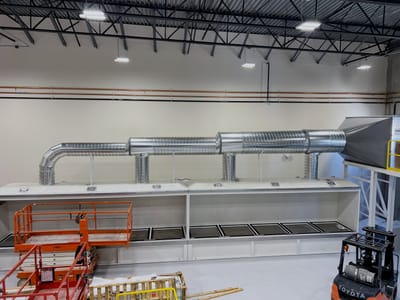
SEED DRYER — ENCLOSURE AND SUPPLY DUCTSEED PROCESSING · DWG PRJ-02 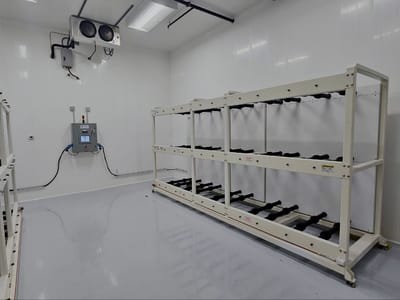
PRIMING ROOM — RACKS AND CONTROLS


Service area
Nearby
Divisions
Related services
Custom Processing Equipment Design and Build
Custom processing equipment, skid systems, and automated material handling. Sanitary washdown design, PLC-ready. Engineers and fabricators under one roof.
Specialized Industrial Enclosures
Process, hazardous-area, food and pharmaceutical, and equipment enclosures. Explosion rooms and clean process rooms designed, built, and installed.
Structural Steel Fabrication and Erection
Structural and miscellaneous steel fabrication in Rancho Cordova. Platforms, mezzanines, supports, and access systems. Engineers on staff who stamp.
Industries
Industries this work runs in
Food and Beverage Processing Equipment Installation
Food and beverage processing equipment installation inside live plants. Sanitary supports, utility tie-ins, washdown design. 600 miles from Sacramento.
Seed Processing and Conditioning Equipment
Seed processing and conditioning equipment: dryers, priming rooms, cleaners, conveyance. Designed, fabricated, and installed by one accountable team.
Packaging Line Installation and Integration
Packaging line installation and integration. Fillers, cappers, labelers, case packers, palletizers, conveyors. Set, tied in, and ready to commission.
Portfolio
Related project work
Seed Dryer Design, Fabrication, and Installation
Seed dryer design, fabrication, and installation for agricultural processing. Custom equipment built by engineers and fabricators under one roof.
Seed Priming Room Enclosures
Controlled-environment process enclosures for seed priming and conditioning. Designed, fabricated, and installed as specialized enclosure projects.
Coverage
- 600 mi
- Field services, installation, fabrication delivery, and rigging from Sacramento
- 300 mi
- Full EPC delivery and preventative-maintenance programs
- Nationwide
- Engineering, design, and fabrication for shipment
Frequently Asked Questions
How far is Fresno from your shop, and do you charge to get there?
171 miles down Highway 99 from Rancho Cordova, roughly two and a half hours. Mobilization for a Fresno project is quoted as a line item so you can see it rather than having it buried in the unit price. On larger projects it is often folded in. What we will not do is quote a Fresno job without coming down to field-verify first — measuring off a drawing at that distance is how a truckload of steel arrives that does not fit.
Do you meet San Joaquin Valley Air District dust-control requirements?
Yes, and we plan for them at the start of a project rather than the week before mobilizing. Valley Air District Rule 8021 requires 48 hours of advance written notice for earthmoving on sites of one acre or more, and a District-approved Dust Control Plan before construction on non-residential projects disturbing five or more acres or any project moving 2,500 cubic yards or more within three days. We handle our own compliance documentation so it does not land on your environmental coordinator.
Can you build equipment that meets food-grade and washdown requirements?
Yes. Sanitary design is a core part of what we build — food and pharmaceutical enclosures, washdown-rated equipment surrounds, and processing equipment specified for the cleaning chemistry and pressure it will actually see. Seam treatment, drainage angles, material selection, and access for cleaning get decided during design, not corrected after the first inspection.
When should a Fresno plant schedule structural or equipment work?
December through March, in most cases. Fresno processing runs hard from mid-summer through fall as nut, raisin, tomato, and produce seasons stack up, so line-affecting work has to happen in the off-season — and that window fills early. If you already know your shutdown date, give it to us first and we will schedule engineering, procurement, and fabrication backward from it. Plan on the fog season too; visibility on 99 in December and January is a real scheduling input.
Do you work with our OEM's technicians on new equipment?
Routinely. Manufacturers build the equipment and distributors sell it — the gap is usually who owns the platform, the access, the guarding, the utility routing, and making the machine actually sit level on your floor. We take that scope and coordinate the split with the OEM tech so their commissioning window is protected and their warranty stays intact.
Call (916) 842-7402
Send drawings, a photo, or a rough scope. We answer with questions before we answer with a number.
Miller 3 Engineering · 2530 Mercantile Dr Ste H, Rancho Cordova, CA 95742 · CA LIC #1136711