INDUSTRY · SEED & AG CONDITIONING · DESIGN NATIONWIDE
Seed Processing and Conditioning Equipment
Dryers, priming rooms, conveyance, and dust control designed by the same company that fabricates and installs them.
Miller 3 Engineering designs, builds, and installs agricultural processing and conditioning equipment, along with the enclosures, structural steel, and utility tie-ins that make it work in a real facility. Engineers and fabricators under one roof.
The short version
Dryers, priming rooms, conveyance, and dust control from one company
Designed, fabricated, and installed in house
The season is a hard calendar, so the schedule is built backwards from your window
Sequenced around conditioning, not around us
Dust collection is scoped in at design, not deferred to a later phase
Collector, ductwork, and make-up air
Engineering and fabrication nationwide; install and rigging inside 600 miles
600 mi field · nationwide design
Seed conditioning equipment is not something you order from a catalog
Seed operations run on process steps that are specific to a crop, a lot size, a moisture target, and a customer specification that changed last season. There is no shelf product for most of it. So the plant does one of three things.
It buys the closest general-purpose machine and works around the 40% that does not fit. It hires a design engineer, gets a clean package, sends that package to a fab shop, and pays for rework when the detail that cannot be welded from the inside shows up on the floor. Or it builds the thing in house out of what is in the yard, which works until the person who built it retires.
The season, and the dust
The season does not wait for any of that. Conditioning capacity is a hard calendar. Drying, cleaning, treating, priming, and packaging have to move a defined volume in a defined window, and the equipment either holds that rate or the operation eats the difference in overtime, carryover, and lost quality.
Then there is the dust. Ag conditioning generates it constantly, and it is a housekeeping problem, an air quality problem, a maintenance problem, and a combustibility question all at once. It is also the scope most often deferred because the collector and ductwork are not the machine anyone was excited to buy.
Equipment built for your crop, your rate, and your building
The dryer is sized for the volume you actually run, with airflow, heat, and residence time set for the seed you actually handle, and it fits through the door and under the beam that exists today.
The priming room is a real enclosure: sealed, finished, serviceable, and separated from the rest of the plant so the process inside it stays controlled and the plant outside it stays clean.
What we size it against
Conveyance moves product between steps without excessive handling, at the transfer heights the equipment requires, on structural support that was engineered rather than improvised. Access to every point that needs daily attention is a platform with guardrail, reachable without a borrowed ladder.
Dust collection is installed with the process, not two years later. Collectors, ductwork, fans, and make-up air are sized as a system.
And when a component wears out in year four, your mechanic can get to it, and the shop that built it still has the drawings.
Design and fabrication in the same building, install in the same contract
Engineers and fabricators under one roof. No disconnect between design and fabrication.
Design-only engineers produce packages that do not fabricate cleanly. Fab-only shops build what is drawn even when it will not work. M3E does both, in Rancho Cordova, which means constructability review is not a meeting. It is somebody walking twenty feet and saying that will not work, try this.
What that changes on your job
The path on a seed project runs concept development and problem definition, 3D modeling and design refinement, fabrication-ready drawings, prototype builds where the process is uncertain, production fabrication, and then installation and commissioning inside 600 miles of Sacramento. Design work and fabrication go nationwide, so an operation outside the field radius can still get equipment designed, built, tested, and shipped.
On the install side, the same discipline that governs live-plant work applies here: pre-installation site walks and constructability review, sequencing aligned with plant operations, fabrication of custom supports and modifications as required, precision equipment setting, anchoring, and alignment, utility coordination and installation, and commissioning support with punch-list closeout.
Practical, field-driven solutions when conditions differ from drawings. In an older ag facility, conditions always differ from drawings.
What we design, build, and install for seed operations
| Scope | Typical work |
|---|---|
| Seed dryers | Design, fabrication, and installation of drying equipment sized to the operation |
| Seed priming rooms | Process enclosures built and installed for controlled conditioning steps |
| Agricultural processing and conditioning equipment | Cleaners, treaters, elevators, sizing and grading equipment, priming systems |
| Custom processing equipment | Purpose-built machines for a process step no catalog machine handles |
| Conveyors and material handling | Belt, bucket, screw, and pneumatic conveyance with transfer points and guarding |
| Dust collection and air handling | Collectors, ductwork, fans, make-up air, environmental systems |
| Structural steel supports and access | Equipment support steel, mezzanines, catwalks, platforms, ladders, guardrail |
| Process and equipment enclosures | Separation of a process from the plant, or the plant from the process |
| Utility tie-ins | Process utility piping, compressed air, industrial plumbing, secondary containment |
| Retrofits and performance upgrades | Capacity, changeover time, guarding, interlocks on equipment you already own |
Custom processing equipment design and build · Specialized industrial enclosures
Built and installed
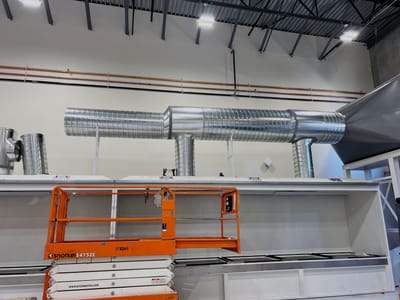
SUPPLY DUCT — HEADER AND BRANCH TAKEOFFS 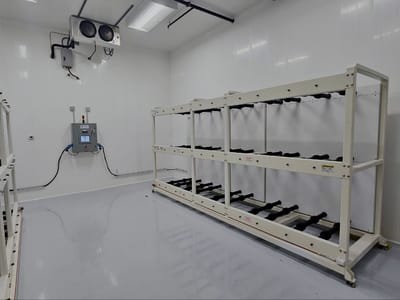
PRIMING ROOM — RACKS AND CONTROLS


Coverage for seed and ag operations
| Scope | Coverage |
|---|---|
| Installation, field services, and rigging | 600 miles from Sacramento |
| Preventative maintenance programs | 300 miles from Sacramento |
| Full EPC delivery | 300 miles from Sacramento |
| Engineering and design | Nationwide |
| Fabrication and shipping | Nationwide |
Seed operations outside the 600-mile field radius still have a path: we design, build, test, and ship the equipment, and your local crew or the OEM sets it.
Divisions
Related services
Custom Processing Equipment Design and Build
Custom processing equipment, skid systems, and automated material handling. Sanitary washdown design, PLC-ready. Engineers and fabricators under one roof.
Specialized Industrial Enclosures
Process, hazardous-area, food and pharmaceutical, and equipment enclosures. Explosion rooms and clean process rooms designed, built, and installed.
Structural Steel Fabrication and Erection
Structural and miscellaneous steel fabrication in Rancho Cordova. Platforms, mezzanines, supports, and access systems. Engineers on staff who stamp.
Portfolio
Related project work
Seed Dryer Design, Fabrication, and Installation
Seed dryer design, fabrication, and installation for agricultural processing. Custom equipment built by engineers and fabricators under one roof.
Seed Priming Room Enclosures
Controlled-environment process enclosures for seed priming and conditioning. Designed, fabricated, and installed as specialized enclosure projects.
Coverage
- 600 mi
- Field services, installation, fabrication delivery, and rigging from Sacramento
- 300 mi
- Full EPC delivery and preventative-maintenance programs
- Nationwide
- Engineering, design, and fabrication for shipment
Common questions
Do you build seed dryers to order, or is there a standard model?
To order. Seed drying equipment gets designed around the crop, the moisture target, the volume you have to move in the window, and the building it has to fit inside. We start with concept development and problem definition, move to 3D modeling and fabrication-ready drawings, and build a prototype subassembly first when part of the process is uncertain. That is cheaper than discovering the problem in a finished machine.
What is a priming room, and what does M3E actually supply?
A priming room is a process enclosure that separates a controlled conditioning step from the rest of the plant. Our specialized enclosures division designs, builds, and installs process enclosures, including the structure, the panelization, and the tie-ins the process needs. Seed priming rooms are in our project portfolio. Design work is available nationwide and build and installation reach 600 miles from Sacramento.
Can you install equipment we bought from an equipment manufacturer?
Yes. Installing already-purchased equipment for the end user is a defined service line within 600 miles of Sacramento. We do not require that the equipment came through us. Structural supports, conveyance integration, dust collection, and utility tie-ins are usually part of the same contract, because those are the scopes that fall between the manufacturer and the plant and stall the schedule.
Our dust collection is undersized. Can you fix that separately from a new equipment project?
Yes. Dust collection and air handling is a standalone scope: collectors, ductwork, fans, make-up air, and the structural support and access that go with them. It is also one of the more common retrofit requests, because collection capacity gets sized to the plant that existed when it was installed and then the plant grows.
How far can you travel, and does that change what you can do?
It does, and the tiers are firm. Installation, field services, and rigging reach 600 miles from Sacramento. Preventative maintenance programs and full EPC delivery reach 300 miles, because both require ongoing on-site presence. Engineering, design, fabrication, and shipping are available nationwide. See the service area and coverage tiers.
Can you take the whole project, from process concept through startup?
Within 300 miles, yes. Full EPC delivery covers engineering, procurement, construction, project management, and commissioning and startup support, with a single point of responsibility for the entire project lifecycle. Outside 300 miles we scope it as design-build-ship plus installation instead. See full EPC delivery.
Tell us the crop, the volume, and the window
Rate, moisture target, lot size, and the weeks you have to get it done. That is enough to start a real conversation about whether you need a machine, a retrofit, or more air.